
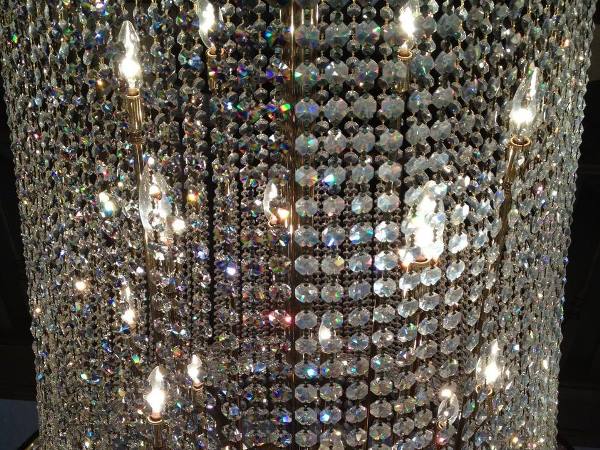
Nothing commands a room quite like the refracted sparkle of an authentic antique crystal chandelier. Yet time, domestic soot, structural fatigue, and past electrical bodges can leave these grand fixtures looking dull, unsafe, or visibly lopsided. If your heritage centrepiece has lost its radiance or hangs precariously from your London ceiling, how do you restore its original brilliance without compromising its historic integrity?
Restoring fine lighting requires a delicate balance of period connoisseurship, specialist glass repair, and modern UK electrical standards. This guide covers the essential steps of antique lighting conservation, from diagnosing structural weaknesses to rewiring delicate brass arms.
Key Takeaways at a Glance
| Aspect | Diagnostic Indicator | Recommended Action |
| Glass Condition | Fleabites, chips, clouding, chemical etching | Ultrasonic cleaning, lapidary hand-polishing, or historic replacements |
| Fixings & Pins | Brittle wire, green verdigris, rusted steel staples | Re-pinning using corrosion-resistant annealed brass or silver wire |
| Framework & Arms | Sagging frames, hairline stress fractures, loose rosettes | Dismantling, structural realignment, period-appropriate brazing |
| Electrical Safety | Vulcanised rubber insulation, twin-core flex, ungrounded metal | Full rewire to BS 7671 standards with braided silk flex |
| Cleaning Routine | Greasy film, nicotine tint, static dust build-up | Specialist isopropyl/distilled water misting; avoid harsh detergents |
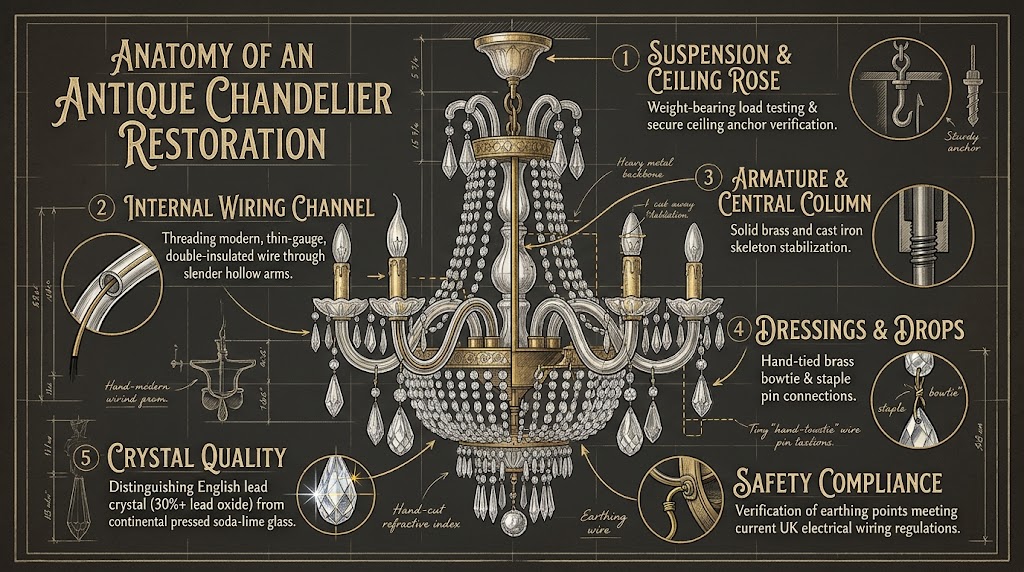
Assessing the Damage: Common Issues in Antique Lighting Fixtures
Before undertaking any repair, an accurate assessment distinguishes harmless historical patina from genuine structural degradation.
- Brittleness in Antique Pinning Wire
Over decades, Victorian and Georgian chandeliers undergo metal fatigue. The original soft copper or brass wire staples that connect crystal drops to the frame oxidise, turning brittle and prone to sudden snapping under minimal vibration.
- Micro-Fractures and Chipped Facets
Historic lead crystal is remarkably soft compared to modern tempered glass. Improper handling during domestic cleaning frequently causes “fleabiting” around the drilled pinning holes or chipped points on French pendalogues and Albert drops.
- Outdated and Dangerous Wiring
Fixtures dating from the early-to-mid 20th century often retain dangerous wiring. Old vulcanised Indian rubber (VIR) becomes rock-hard and crumbles when disturbed, while original ungrounded metalwork creates severe shock and fire hazards under modern power loads.
[Visual Check: Sagging Arms, Missing Prisms, Frayed Flex]
│
┌────────────────────────┴────────────────────────┐
▼                                                 ▼
[Structural & Glass]                          [Electrical Hazards]
- Re-pinning with annealed brass • Strip out old VIR/PVC flex
- Lapidary diamond-edge grinding • Thread BS 7671 certified cable
- Re-seating bent iron armature • Establish secure internal earth
The Step-by-Step Crystal Chandelier Restoration Process
Complete conservation must follow an orderly conservation methodology to avoid irreversible damage to rare glasswork.
Safe Dismantling and Mapping
Every teardrop, bead strand, and bobeche must be mapped before disassembly. Restorers produce detailed photographic surveys and alphanumeric diagrams to ensure each unique crystal returns to its historic placement.
Ultrasonic Cleaning and Lapidary Repairs
Standard domestic cleaning sprays contain ammonia, which strips antique gilding and clouds lead crystal. Instead, individual crystals undergo temperature-controlled ultrasonic baths in neutral, demineralised solutions. For damaged pieces, specialist glass restorers employ lapidary diamond wheels to gently re-facet chipped edges, followed by cerium oxide polishing to bring back luminous optical refraction. Discover tips for everyday maintenance in our seasonal chandelier care checklist.
Re-pinning Crystal Chains
Original wiring should be replaced with hand-turned, high-tensile annealed brass wire or nickel-plated pins. Restorers hand-bend traditional English “arrowhead” or “bowtie” clips to match the exact gauge and aesthetic of the chandelier’s manufacturing era.
UK Electrical Rewiring and Certification
All vintage chandeliers installed across the UK must comply with the current IET Wiring Regulations (BS 7671).
- Modern thin-wall, high-temperature cables replace bulky wires.
- Multi-tier fixtures receive discreet earthing to eliminate stray current risks across the metal framework.
- Original brass bayonet (B22/B15) or Edison screw (E14) lampholders are restored or substituted with authentic, CE/UKCA-certified brass equivalents compatible with low-heat, dimmable LED filament lamps.
Preserving Value: Restoration vs. Over-Polishing
When conserving metalwork—whether mercury-gilded bronze (ormolu), patinated brass, or silver plate—heavy machine polishing can drastically reduce the market and historical value of the fixture, as warned by conservation bodies such as the Institute of Conservation (Icon).
True conservation retains the natural, time-earned darkening in the low-relief carvings while removing corrosion, stubborn grime, and abrasive salt residues.
Frequently Asked Questions
Can broken crystal arms on an antique chandelier be repaired?
Yes. Depending on the break, specialists either use high-clarity, UV-cured optical adhesives matched to the refractive index of lead glass, or join the pieces with concealed internal brass dowels. For irreparable breaks, an exact replica arm can be hand-blown and cut by a master glassblower.
How much does it cost to restore an antique chandelier in London?
Costs vary based on the diameter, number of tiers, and condition. A simple sympathetic clean and re-pinning of a small bedroom chandelier may start from a few hundred pounds, whereas a full dismantle, rewiring, lapidary repair, and re-hanging of a multi-tiered Georgian or Waterford fixture in a central London townhouse requires bespoke quotation following an on-site survey.
Is it safe to convert an antique gasolier to electricity?
Yes, provided it is undertaken by a certified heritage lighting technician. Gas pipes inside the arms can often be adapted to carry miniature electrical cables, fitting period-correct brass candle sleeves to preserve its original silhouette.
Bring Your Centrepiece Back to Life
An authentic crystal chandelier is more than a light fitting; it is a vital architectural anchor for your home. Neglecting deteriorated wiring or crumbling crystal pins risks catastrophic failure and the loss of irreplaceable period craftsmanship. Professional conservation repairs invisible damage, ensures full electrical safety, and revives the breathtaking, kaleidoscopic light your room was designed to enjoy.
Is your heirloom chandelier ready for expert care? Trust the specialists at Royale Chandelier Restoration Services for premier in-situ cleaning, precision glass conservation, rewiring, and bespoke restoration across London and the UK.
Author Information & Trust Section
This guide was prepared using trusted industry sources and reviewed for accuracy, clarity, and usefulness.