
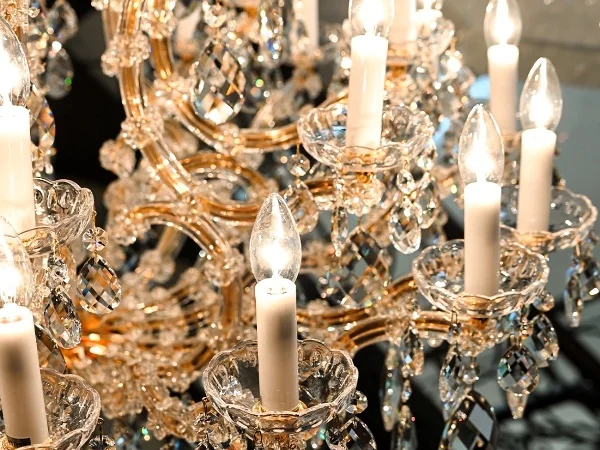
A statement chandelier is often the crown jewel of a British home, commanding attention in Georgian townhouses, Victorian drawing rooms, and contemporary apartments alike. Yet behind the dazzling display of faceted crystal and hand-finished metalwork sits an intricate assembly of delicate glass, weight-bearing joints, and electrical circuitry. When a light flickers or a crystal drop works loose, your initial instinct may be to fetch a stepladder and attempt a quick weekend repair.
Taking a do-it-yourself approach to complex light fittings introduces serious hazards. Beyond the risk of permanently damaging an antique or high-value piece, DIY attempts regularly fail to resolve underlying electrical and structural faults. How do you know when a minor issue crosses the line into a specialist task? Recognizing the warning signs early protects your home from electrical fire risks, ceiling damage, and costly glass breakages. Here are the 10 critical signs your chandelier needs professional repair instead of DIY fixes.
Key Takeaways at a Glance
|
Sign / Symptom |
Underlying Risk |
Recommended Action |
|
Persistent Flickering / Buzzing |
Arcing wires, failing transformers, or degraded insulation |
Isolate power at the consumer unit; arrange an electrical inspection |
|
Warm or Scorched Sockets |
Thermal fatigue, improper bulb wattage, or short circuits |
Cease use immediately; replace scorched lampholders with ceramic units |
|
Canopy Tilt or Plaster Cracks |
Failing timber pattress or fatigued ceiling anchor |
Relieve structural load; install certified joist-spanning pattress |
|
Brittle Vintage Cabling |
Perished vulcanised rubber (VIR) or frayed cotton braid |
Complete rewiring compliant with BS 7671 (IET Wiring Regulations) |
|
Corroded or Snapped Pins |
Dropped crystals and mechanical stress on glass holes |
Re-pinning by hand with non-corrosive brass or stainless wire |
|
Unstable Gasolier Arms |
Friction points along internal conduits causing earth faults |
Specialised rewiring using thin-wall silicone or Teflon cabling |
1. Persistent Flickering, Humming, or Buzzing
Occasional bulb replacement is ordinary maintenance. However, if modern LED bulbs continue to flicker, or if the central body emits an audible hum or intermittent buzz, the issue rarely lies within the lamp itself.
In older UK fittings, electrical buzzing typically indicates internal arcing, where current jumps across a loose contact or damaged terminal within the chandelier core. In contemporary fittings, humming often points to a failing internal transformer or an incompatible trailing-edge dimmer. Poking around inside the central hub without diagnostic instruments risks electrical shock and creates latent fire hazards behind your ceiling.
2. Scorching, Discolouration, or Heat Around Lamp Sockets
If you detect a faint burnt odour, notice brown scorching around candle tubes, or find metal lampholders warm to the touch hours after switching off the fixture, you are facing hazardous thermal buildup.
Historic lighting frequently suffers from decades of owners fitting high-wattage incandescent bulbs exceeding original design tolerances. Over years, this excess heat bakes the lampholders, seizing brass threads and degrading ceramic collars. A specialist repair involves stripping out heat-damaged sockets and replacing them with modern, heat-resistant porcelain or phenolic components.
3. Ceiling Roses Pulling Away or Visible Canopy Tilt
One of the most alarming sights in a period property is a chandelier ceiling canopy that appears visibly tilted, or a decorative plaster rose displaying hairline cracks around the collar.
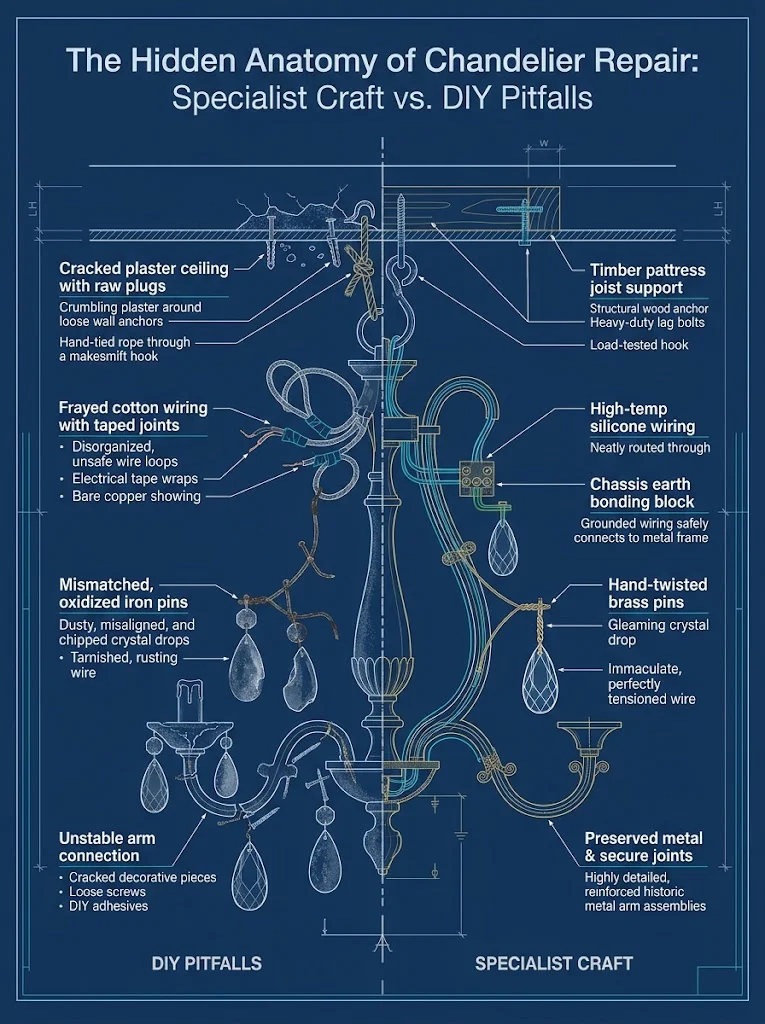
A chandelier can weigh anywhere from 15kg to over 80kg. In London’s historic homes, fittings often hang from fragile lath-and-plaster ceilings. A shifting rose is not merely cosmetic; it frequently indicates that the internal timber pattress above the ceiling has shifted, wood screws have pulled free from aged joists, or the suspension hook has fatigued. Tightening the collar from below masks a potential collapse. Professional lighting restorers inspect the floor void above to install certified, weight-rated suspension bridges anchored across structural timbers.
To understand structural anchoring and ceiling preservation techniques in period architecture, read our guide on restoring antique chandeliers in London period homes.
4. Vintage Cabling and Deteriorated Insulation
If your chandelier has not been rewired in the past three decades, its internal cabling is operating on borrowed time. Older UK installations relied heavily on vulcanised Indian rubber (VIR) or braided cotton sheathing.
Over decades, heat causes rubber insulation to dry, crack, and turn to dust inside narrow brass conduit arms. The moment you attempt to clean or adjust an arm, the fractured insulation flakes away, leaving exposed copper touching the conductive metal frame. Under modern UK electrical standards (BS 7671), all exposed metalwork must be reliably bonded to earth. Bringing historic pieces into compliance requires threading ultra-thin, double-insulated silicone or Teflon conductors through tight antique castings.
5. Corroded, Brittle, or Snapped Crystal Wire Pins
When crystal festoons, lustres, or drops fall without warning, the culprit is almost always oxidised pinning wire. Historically, crystal beads were joined using thin iron, copper, or brass pins.
In urban atmospheres, moisture and atmospheric sulphur corrode these delicate wires. As rust expands, it creates mechanical stress inside the minute drilled holes of the crystal, shearing the glass. Using pliers to twist copper wire or domestic paperclips through crystal holes often cracks the prisms. Conservators unpin entire festoons, ultrasonically cleanse every prism, and re-pin the assembly by hand using non-tarnish conservation brass wire.
6. Loose, Drooping, or Misaligned Arms
Chandelier arms are subject to rotational torque and vibrational stress from household foot traffic. If an arm sways when lightly touched, droops below the horizontal plane, or rotates within the central plate, the internal securing nuts have stripped or loosened.
Attempting to tighten these arms from the outside can twist and sever the internal electrical feed passing through the arm’s threaded hollow rod. A specialist dismantles the central body casting, inspects the internal threads for metal fatigue, and reseats the arm with thread-locking compounds and lock washers to guarantee lasting stability.
7. Uneven Dimming and Electrical Tripping
Does switching on your dining room chandelier trip your consumer unit’s Residual Current Device (RCD) or miniature circuit breaker (MCB)? Does the chandelier fail to dim smoothly, flickering below 50% brightness?
When an RCD trips immediately, it indicates a direct earth fault—current is leaking to the metal casing due to compromised wire insulation. If the circuit trips intermittently, thermal expansion may be forcing a degraded conductor into contact with an internal brass burr. Modern dimming systems also require precise load matching. A specialist technician uses high-voltage insulation resistance testing to isolate elusive micro-faults without destructive trial and error.
For detailed advice on selecting complementary dimming controls and low-heat vintage lamps, explore our overview of energy-efficient LED conversions for classic chandeliers.
8. Unstable Gasolier Conversions
In the late 19th and early 20th centuries, thousands of London residences converted their gas-lit chandeliers (“gasoliers”) into modern electric fixtures.
Gasolier arms were engineered to hold low-pressure gas, featuring sharp interior 90-degree elbows and directional shutoff keys never designed for insulated electrical flex. Early conversion technicians frequently forced ungrounded wiring through these abrasive channels. If your antique gasolier exhibits stiff gas taps or historic soldered joints, DIY rewiring can tear delicate period metal. Specialists use endoscopic inspection tools, chemical de-burring, and micro-sheathed cabling to rewire these fittings safely without altering their vintage silhouette.
9. Clouded Crystal Prisms and Damaged Ormolu Finishes
Sometimes deterioration is chemical rather than mechanical. Decades of domestic dust, gas fires, and open candles leave an oily film that clings tenaciously to lead glass.
Well-meaning homeowners often spray domestic glass cleaners or vinegar solutions directly onto hung chandeliers. This mistake causes significant damage:
- Liquid penetrates metal cups and sockets, corroding internal wiring and inducing electrical shorts.
- Ammonia and harsh acids dissolve historic lacquer and strip the gilded finish of ormolu (fire-gilded bronze) and patinated brass, leaving splotchy chemical scars.
- Un-rinsed cleaning detergents collect inside crystal pinholes, accelerating metal corrosion.
Conservation-grade refurbishment demands total de-installation, aqueous ultrasonic degreasing in demineralised water, and hand application of microcrystalline conservation waxes, as detailed by heritage bodies like the Institute of Conservation.
10. Post-Move Reassembly After Property Relocation
Moving between residences in the UK is one of the most common times chandeliers suffer irreversible damage. Whether moving into an expansive country estate or a central London townhouse, re-hanging a complex light fitting is not standard work for domestic removal companies.
Tackling the installation of an unlabelled, disassembled chandelier without circuit diagrams or structural load verifications risks bent arms, misplaced crystal sets, and improperly calculated ceiling loads. Engaging an accredited specialist to survey ceiling joists, assemble framework components, and perform comprehensive Portable Appliance Testing (PAT) ensures your investment is safely secured.
Frequently Asked Questions
Can I rewire an antique chandelier myself if I have basic DIY electrical knowledge?
Rewiring an antique chandelier requires far more than wiring a domestic plug. Historic castings lack modern insulation barriers, feature sharp internal turns, and have no dedicated channel for modern earth conductors. Under UK Building Regulations, domestic electrical work must comply with BS 7671 standards. Uncertified amateur rewiring that leads to a fire or electrical injury will invalidate your home insurance.
How much does professional chandelier repair typically cost in the UK?
Cost depends on scale, provenance, weight, and condition. A straightforward on-site socket replacement and PAT electrical certification for a modern fitting starts from a few hundred pounds. A comprehensive conservation of an 18th-century crystal ormolu chandelier—involving complete disassembly, structural pattress anchoring, ultrasonic crystal washing, and micro-cable rewiring—reflects the specialist bench hours required.
Is it safe to clean a chandelier while it is hanging from the ceiling?
Light cosmetic dusting with an ostrich-feather duster or microfibre glove is safe while the fixture is suspended, provided the power is isolated at the mains. However, spraying liquid cleaners or rotating the fixture on its axis risks bending internal pins, twisting internal wires, and stripping ceiling fixings.
Safeguarding Your Centrepiece for the Future
An extraordinary chandelier is far more than a source of illumination; it is a preserved piece of decorative history and the visual focal point of your home. While the temptation to carry out quick fixes with household tools is understandable, high-voltage electricity, substantial physical weight, and irreplaceable historic craftsmanship demand seasoned expertise.
Recognising early warning signs—from subtle electrical buzzing to tired ceiling fixings and corroded pins—allows you to intervene before minor faults develop into safety hazards or irreparable structural damage.
If your luminaire is exhibiting any of these telltale warning signs, do not leave safety or provenance to chance. Restore your centrepiece to immaculate safety and museum-grade radiance with the dedicated artisans at Royale Chandelier Repairing Service.
Call us now for free consultation +44-800-193-6133