

Chandelier Care & Inspection in Essex & Home Counties: A fine crystal or brass chandelier forms the magnificent focal point of any heritage townhouse, barn conversion, or country estate. Yet beyond its dazzling illumination, high-value statement lighting carries substantial structural weight and delicate engineering. Dust accumulation, microscopic brass fatigue, and degraded ceiling fixings pose genuine hazards over time. How certain are you that your ceiling fixture remains secure, electrically sound, and sparkling as intended?
Proper chandelier care and regular structural inspection safeguard both historical aesthetic value and household safety. This guide outlines professional inspection procedures, preventative maintenance, and safety regulations designed to protect statement lighting throughout Essex, Hertfordshire, Buckinghamshire, and across the wider Home Counties.
Key Takeaways at a Glance
| Focus Area | Typical Risk Factor | Recommended Inspection Interval | Best Practice Action |
| Ceiling Anchors & Joists | Timber fatigue, plaster stress cracking | Every 12–24 months | Load-bearing weight testing & joist reinforcement inspection |
| Crystal Dressings & Pins | Brittle brass pins, ultrasonic dust grime | Every 6–12 months | Hand-pinning inspection and neutral demineralised spray cleaning |
| Internal Wiring & Earthing | Heat-perished rubber flex, loose ground | Every 3–5 years | BS 7671 electrical testing and continuity checks |
| Metal Arms & Frame | Torsional sag, stress fractures | Every 12 months | Alignment survey and non-destructive joint testing |
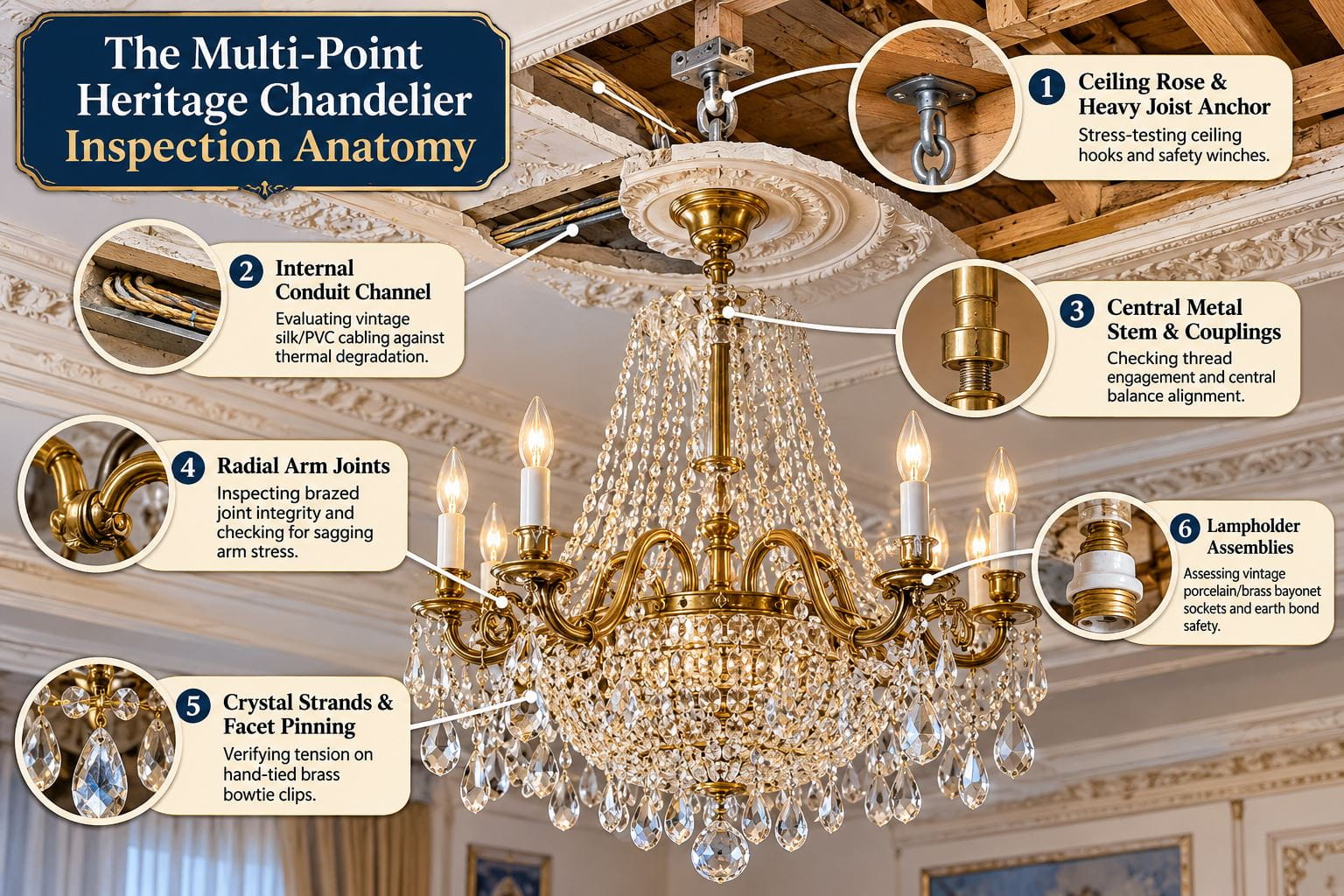
Why Chandelier Care & Inspection in Essex & Home Counties Matters
Properties across Essex and the Home Counties range from timber-framed Tudor manors and Georgian rectories to contemporary luxury developments. Each property type introduces distinct environmental factors that influence lighting longevity:
- Structural Movement in Heritage Homes: Traditional lime plaster and timber joists expand and contract with seasonal humidity, gradually loosening screw threads or shifting support bridles.
- Open Fire & Environmental Soot: Rural estates with open hearths or wood burners generate microscopic airborne soot that binds with atmospheric moisture, creating an acidic, abrasive film over delicate lead crystal.
- Modern High-Vibration Impacts: Nearby transit corridors or domestic renovations cause micro-vibrations that loosen crystal linkage pins over time.
Regular safety assessments prevent catastrophic ceiling failure and preserve vintage metal patinas that harsh domestic chemical sprays permanently destroy.
[Routine Inspection Check]
│
┌────────────────────┴────────────────────┐
▼                                         ▼
[Mechanical & Frame]                     [Electrical & Cable]
- Timber anchor load-test • Cable insulation integrity
- Crystal pin tension check • BS 7671 earthing verification
- Arm alignment & brazing check • Heat damage at lampholders
Critical Structural and Electrical Safety Checklist
Fine luminaires require an inspection process that respects both antique materials and current British electrical safety directives.
- Structural Anchor and Winch Testing
Large Maria Theresa or Waterford-style fixtures can easily weigh between 30 and 150 kilograms. An inspection verifies whether ceiling roses conceal purpose-built timber trimmers or unreinforced plasterboard fixings. If a motorized chandelier winch is installed, cables, pulleys, and secondary safety arrest mechanisms must be examined for wire rope fraying.
- Rewiring Compliance with British Standards
Vintage chandeliers often retain vulcanised Indian rubber (VIR) cabling or single-insulated flexes running through hollow brass tubing. As outlined in the IET Wiring Regulations (BS 7671), all modern installations must maintain adequate earth bonding and thermal cable ratings. Routine inspection checks for:
- Perished insulation inside narrow heat zones near lampholders.
- Complete continuity across all decorative metal surfaces to ground.
- Adaptation to low-energy LED dimming without overload risks.
For a deeper dive into period lighting safety, review our guide to heritage lighting rewiring.
- Glass Preservation and Lapidary Assessment
Historic lead crystal contains up to 30% lead oxide, which imparts renowned sparkle but makes the glass softer than modern window panes. When crystals rub against each other during draughts or cleaning, edge chipping (fleabiting) occurs.
Preventative Chandelier Maintenance for Homeowners
Between professional engineering audits, regular preservation protects delicate surfaces:
- Avoid Revolving the Frame: Never spin a chandelier while cleaning. Rotating a suspended fixture twists suspension hooks, loosens ceiling threaded rods, and unscrews internal conduit couplings. Instead, reposition your ladder around the fixture.
- Eliminate Household Chemical Cleaners: Commercial glass detergents contain ammonia, which strips antique mercury gilding (ormolu) and clouds vintage crystal.
- Use Microfibre Gloves for Dry Dusting: Weekly maintenance using lint-free cotton or microfibre gloves prevents dust build-up from bonding with kitchen steam and atmospheric oils.
For comprehensive maintenance schedules, read our seasonal home lighting maintenance checklist.
Frequently Asked Questions
How often should a high-value chandelier be professionally inspected?
In private residences throughout Essex and the Home Counties, a comprehensive structural and electrical inspection is recommended every 12 to 24 months. Fixtures located in commercial settings, venues, or areas with high footfall require annual safety certification under UK workplace safety guidelines.
Can cleaning and inspection be performed without taking the chandelier down?
Yes. Professional technicians perform in-situ inspections and gentle ultrasonic or micro-spray cleans using specialised mobile access towers and drop-cloth catchment systems. Lowering or dismantling is only necessary when significant rewiring or structural joist work is diagnosed.
How do I know if my ceiling joists can hold a heavy chandelier?
A qualified technician conducts an attic or crawlspace inspection to examine the structural timbers, installing cross-bridging trimmers if needed. Standard UK ceiling joists require reinforcement if fixture weights exceed 15 kg without direct rafter anchoring.
Protect Your Investment with Specialist Care
An exquisite chandelier represents both financial value and architectural history. Entrusting its preservation to regular, rigorous inspection prevents costly structural failures and keeps your rooms filled with radiant, kaleidoscopic light.
Ensure your centrepiece remains pristine and completely secure. Explore expert on-site inspection, restoration, and cleaning with Royale Chandelier Services, delivering certified care across Essex and the Home Counties.