
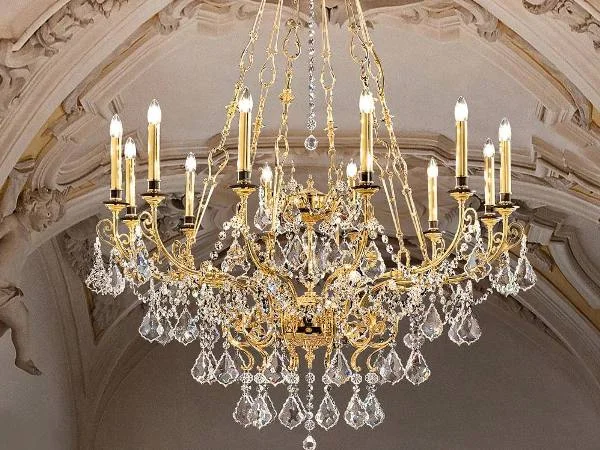
Restoring Antique Chandeliers in London Period Homes: A Specialist’s Guide to Rewiring & Refurbishment
Stepping into a Victorian townhouse in Kensington or a Georgian terrace in Bloomsbury, your eyes are immediately drawn upward. High ceilings, intricate plaster cornicing, and at the centre of it all, a timeless luminary. Yet behind the warm glow of lead crystal and patinated brass lies a common dilemma: how do you preserve the historical integrity of antique chandeliers in London while ensuring they meet contemporary electrical safety standards?
Centuries of soot, delicate aged glass, compromised wiring, and structural load challenges make chandelier restoration both an art and an exacting engineering discipline. Whether you have inherited a delicate Regency crystal piece or a Victorian gilt-bronze fixture, this guide explores the full restoration lifecycle—from UK wiring compliance to heritage crystal pinning.
Key Takeaways at a Glance
| Aspect | Key Consideration | Best Practice / Standard |
| Electrical Safety | Degrading rubber and cotton wiring | Complete rewiring compliant with BS 7671 (IET Wiring Regulations) |
| Ceiling Support | Fragile lath-and-plaster ceilings | Independent joist pattress timber support; never hang from plaster roses |
| Metal Conservation | Gilt bronze (ormolu) and patinated brass | Non-abrasive chemical stabilisation; preserve original fire-gilding |
| Crystal Care | Lead crystal, drops, and lustres | Ultrasonic de-greasing; replace rusted pins with brass wire |
| Modern Lighting | Heat damage from incandescent bulbs | High CRI (90+) dimmable filament LEDs (2200K–2700K) |
The Anatomy of Antique Chandeliers in London Homes
Before undertaking any restoration work on antique chandeliers in London, you must accurately identify the period, provenance, and construction methods of your fitting. London’s architectural history spans distinct decorative movements, each demanding an individualised conservation approach.
Georgian and Regency (c. 1714–1837)
Regency chandeliers feature dense arrangements of faceted crystal drops, pear drops, and concentric rings of lustres (“waterfall” or “tent” designs). The glass contains high percentages of lead oxide, lending it exceptional refractive brilliance and substantial weight. For an overview of period interior fittings, consult the archives of the Victoria and Albert Museum.
Victorian Grandeur (c. 1837–1901)
Ormolu (gilded bronze) flourished alongside cut glass. Mid-to-late Victorian pieces frequently began life as gasoliers (gas-powered fittings). These are easily identified by hollow tubular arms and gas valves that were converted to early, rudimentary electrical wiring in the 1920s and 1930s.
Edwardian and Art Deco (c. 1901–1939)
Edwardian pieces returned to lighter neoclassical motifs, often featuring Marie Antoinette cut glass or delicate brass ribbon work. Art Deco introduced geometric chrome, pressed glass, and nickel-plated bronze.
Rewiring Antique Chandeliers to Modern UK Standards
The primary reason historic chandeliers fail modern building surveys is electrical obsolescence. Installing an uncertified fixture into a period London home invalidates insurance policies and introduces severe fire risks.
Eliminating Fire Hazards
Many antique chandeliers in London homes converted during the mid-20th century exhibit critical defects:
- Deteriorated rubber and braided cotton insulation that crumbles on contact.
- Unprotected cabling passing over sharp internal brass castings.
- Absence of an earth (ground) conductor, turning a metal chassis into a shock hazard if live wires chafe.
BS 7671 Compliance and Cable Selection
Under current UK Wiring Regulations (BS 7671), all exposed conductive parts of a luminaire must be reliably bonded to earth. Because historic metal castings possess narrow internal conduits, bulky modern flex cannot simply be pulled through.
Restorers utilise bespoke, ultra-thin multi-core cables insulated with silicone or Teflon, sheathed in decorative braided rayon. Each metal arm contains an internal continuous earth conductor bonded to a central brass grounding block within the ceiling canopy.
Modern Lamp Holders
Original bayonet or miniature screw holders are frequently replaced with certified porcelain or brass Small Edison Screw (SES / E14) or Small Bayonet Cap (SBC / B15) holders. These accommodate low-heat, dimmable LED filament bulbs that replicate the candle-lit ambience of 2200K without generating damaging thermal cycles.
To learn more about internal conduit preparation, review our notes on custom brass fabrication for heritage light fittings.
Structural Ceiling Support in Period Residences
Period London residences—particularly listed townhou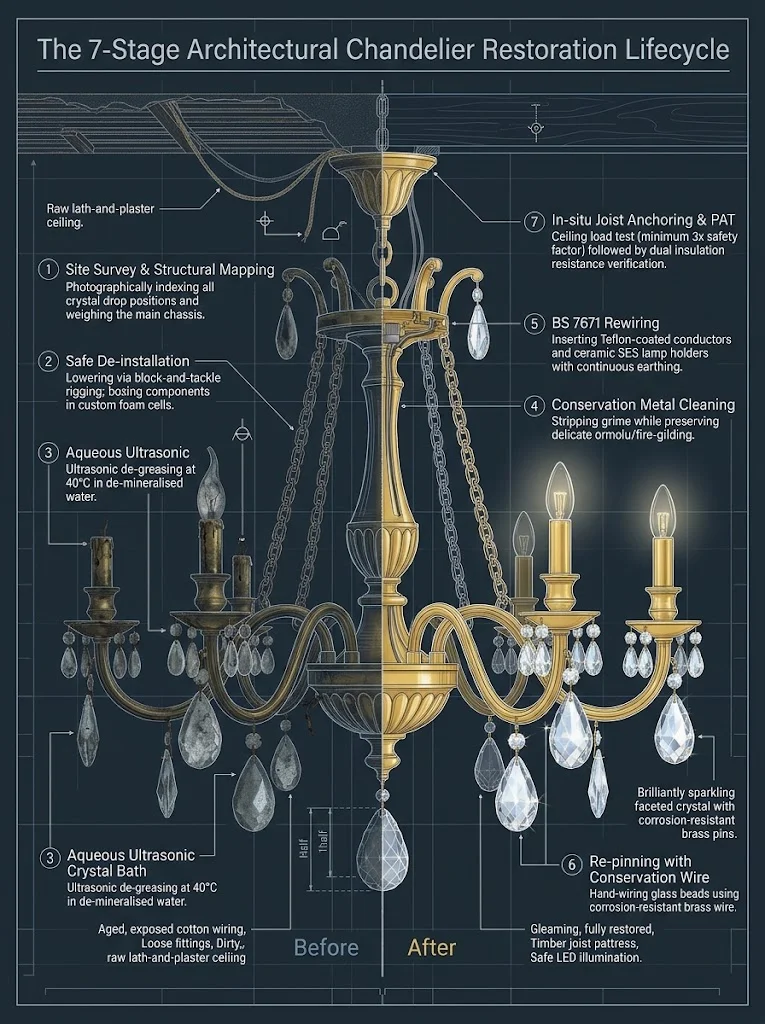 ses in Belgravia, Mayfair, and Marylebone—feature fragile lath-and-plaster ceilings. Suspending a fixture weighing 15kg to 80kg requires dedicated structural anchoring:
- Bypass the Plaster Rose: A decorative plaster rose is ornamental; it cannot support tensile loads.
- Install a Joist Pattress: Floorboards in the room above are lifted so a structural timber pattress can span across the primary floor joists.
- Anchor Through-Bolts: A forged steel eye-bolt passes through the pattress and down through the centre of the rose, carrying the fixture’s weight entirely independently of the plasterwork.
Metalwork Conservation: Ormolu and Patinated Brass
Restoring antique chandelier metalwork requires preserving historic surface integrity rather than polishing to a modern mirror shine.
- Ormolu (Fire-Gilded Bronze): Authentic 18th- and 19th-century ormolu features a microscopic layer of gold fused to bronze. Abrasive polishes strip this layer, exposing base metal. Conservators use non-ionic detergents and solvent baths to remove grease without abrading the gilding.
- Patinated Brass and Bronze: Surface dirt is extracted while leaving intentional historical oxidation intact. High-wear pivot threads are re-tapped, and a protective layer of micro-crystalline wax is buffed on to prevent city sulphur tarnishing.
Crystal Refurbishment and Re-Pinning
The brilliance of an antique chandelier depends on how light interacts with its glass facets. Over decades, open fires, gas lighting, and dust leave an opaque film on the prisms.
- Ultrasonic Cleaning: Each drop and festoon is dismantled and catalogued, then immersed in temperature-controlled ultrasonic cleaning tanks using demineralised water to remove grime without scratching delicate cuts.
- Re-Pinning: Drops are originally linked with soft wire pins. Over time, ferrous pins oxidise, swell, and can crack the crystal holes. Specialists replace damaged links with hand-twisted brass or silvered wire tensioned to allow free movement without clashing.
If individual drops or chandelier arms have cracked over time, read our specialist insight into sourcing and glass-blowing replacement period crystal.
Frequently Asked Questions
Will rewiring an antique chandelier diminish its value?
No. Professional rewiring carried out to conservation standards protects both safety and market value. Auction houses and insurers penalise fixtures with fire hazards. As long as castings are not drilled out and original patinas are respected, rewiring is essential conservation.
How often should a period chandelier be serviced?
A light in-situ feather dusting should be carried out monthly. However, a complete dismantle, ultrasonic crystal wash, and electrical inspection is recommended every 5 to 7 years in urban London environments.
Can a Victorian gasolier be electrified without altering its appearance?
Yes. Modern silicone-sheathed wiring is guided through the original hollow gas pipes, with compact lamp holders seated where the gas mantles once stood, keeping the vintage silhouette intact.
Preserving London’s Illuminated Heritage
An antique chandelier is an architectural narrative suspended in air, reflecting centuries of London craftsmanship. Keeping these fixtures safe and radiant requires an uncompromising balance of historic sensitivity, fine metal and crystal craftsmanship, and rigorous electrical standards.
Entrust your historic lighting to master artisans. Discover comprehensive restoration, rewiring, and conservation services tailored for London’s finest heritage residences at Royale Chandelier Specialist Services.